Zonal Defense
Zonal defending is based on the idea that the defenders should move as a unit. Each one has a (more or less) definite position or role in the defensive formation. If the players shift around in the course of a play, the formation's shape must remain the same. Zonal defense is a very energy-efficient way of pressing the ball.
The main principle of zonal defense is that all the fullbacks move uniformly as a block (this is where the term Block defending comes from.)
In the diagram to the right, we can see how a zonal defense might deal with an
opponent attack By staying in compact form, the fullbacks make it very difficult for their opponents to play the ball directly through the middle.


In the diagram to do left, you can see how the defensive block of players shifts when the ball is passed to the opposite flank. Notice that when attacker 1 moves across the defensive line, he is not followed by defender A, even although he is closest to him. This is another important principle of playing Block defense: players should never cross or make runs in front of each other. This is very important for the two stoppers who constantly have to adjust and make sure that the ball can never be played between them
The third part of the diagram shows how the system works when the ball is in the middle of the pitch. At this moment, the defensive block is centered and has left both flanks uncovered. Fullbacks playing on the outside need to be especially cautious when the ball is in the middle. Take for example the gaping angle left by defenders C and D. There either needs to be pressure on the ball when the opponents have it in the middle or the outside defenders will have to retrieve.
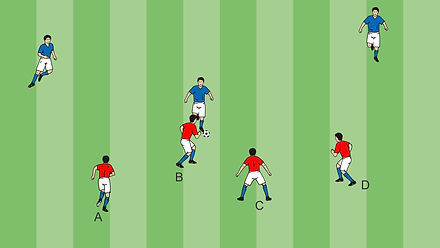
The rotational system of Zonal marking
Zonal defenses use a fairly simple rotation system, as you'll se in the following play. Defender A has just been beaten by Attacker 1. The nearest defender to the ball (B) immediately puts pressure on the ball (Attacker 1.) Steps 2 and 3 show how the entire defensive line shifts over in direction of the ball. More precisely, they exchange their marks in a way which preserves the team formation. The beaten Defender A runs behind the defensive line as soon as he can (Step 5.) From that position, it is easy for him to cover (Step 6) holes (Step 4) left by "the shift."
